

LED screens and digital displays.
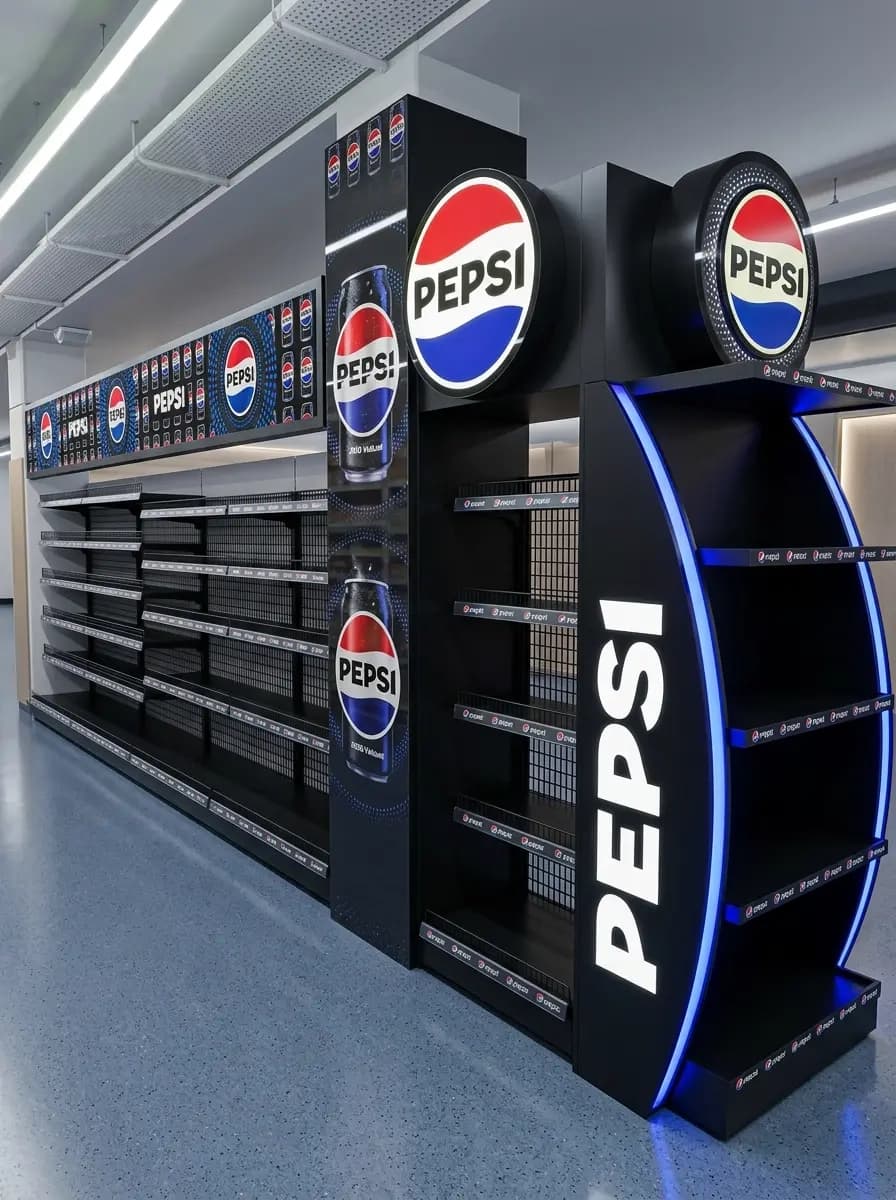
LED screens turn a static display into a moving one. Proink supplies, installs and integrates LED walls, screens, lightboxes and illuminated displays across Lebanon, either as standalone installations or built into custom retail and exhibition units.
What's included
- Indoor LED walls
- Outdoor LED screens
- LED panels & strips
- Illuminated lightboxes
- Backlit signage
- Digital & interactive displays
- Screen integration into custom units
- Content setup
- Installation & calibration
- Maintenance & support
Why add an LED screen to a display?
Movement beats stillness in a retail environment. A shopper scanning an aisle registers motion before they register a logo, which is why a screen inside a display consistently outperforms the same display without one. For a launch, a screen also solves a practical problem: it lets one physical unit carry several messages across a campaign without reprinting anything.
The cost calculation changes over time too. A printed display carries one message and is discarded when the campaign ends. A display with a screen can be updated for the next campaign at no production cost.
What kinds of LED screens does Proink supply?
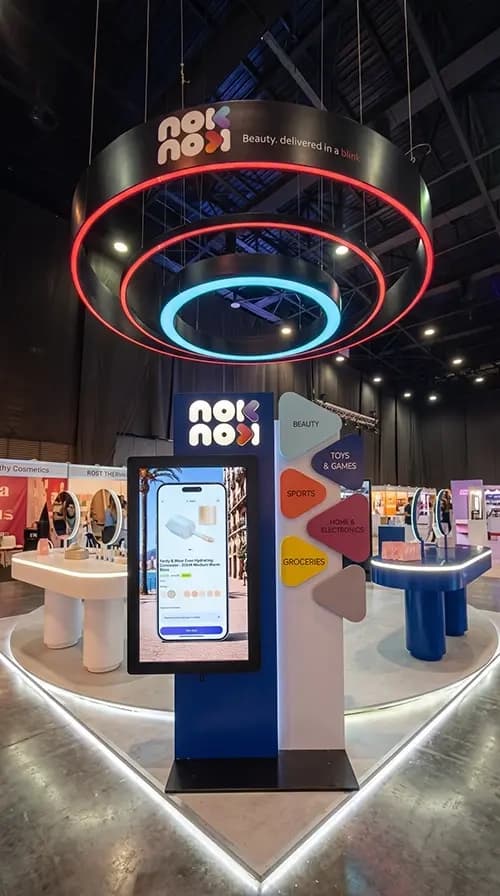
Indoor LED walls are used for retail environments, showrooms and exhibition stands, where viewers stand relatively close. Pixel pitch, the distance between LEDs, determines how close a viewer can stand before the image breaks up, and choosing it correctly for the viewing distance matters more than raw resolution.
Outdoor LED screens are built for weather and daylight. They need significantly higher brightness to remain readable in sun, and proper sealing against rain and dust.
Lightboxes and backlit panels are the simpler, quieter option. Where a full screen is unnecessary, an illuminated panel gives a display presence and depth at a fraction of the cost and with no content to manage.
Interactive and touch displays suit product discovery, wayfinding in malls, and any application where the customer should explore rather than watch.
What should you specify when buying an LED screen?
Pixel pitch sets the minimum viewing distance and how sharp the image looks up close. Brightness, measured in nits, decides whether the screen stays readable in daylight, which is critical outdoors or near a shopfront window.
Indoor and outdoor ratings differ in weather sealing and heat tolerance. Size and aspect ratio determine what content will actually fit, and mounting method, whether wall, floor, hanging or integrated into a unit, has to be settled early because it affects the structure around it. Power supply and ventilation must be planned at design stage rather than solved afterwards.
What does integration into a unit involve?
This is where most suppliers stop and we continue. Buying a screen is straightforward. Building it into a counter or stand so it looks designed rather than added is not.
Integration means planning the cavity, ventilation, cable routing and power access at design stage, and building the structure around the screen dimensions. It also means the screen sits flush and the whole unit reads as one object. When a screen is retrofitted into a unit that was not designed for it, it always looks retrofitted.
Because we design and fabricate the units ourselves, the screen is part of the drawing from the first sketch.
Should you buy or rent an LED screen?
For a permanent retail installation, buying is almost always the better economics. The screen becomes a fixed asset that carries campaign after campaign with no reprint cost, and the payback against repeatedly producing printed graphics is usually quick.
For a single exhibition or a short activation, renting makes more sense. You get the impact for the days you need it without owning hardware that then sits in storage between shows.
The case in between is a brand that exhibits several times a year. There, buying a modular screen that travels between shows often beats renting repeatedly, and we can advise on which side of that line a specific plan falls.
Where do LED screens work best?
Entrances and decision points. A screen positioned where a shopper pauses, at an aisle end, a store entrance or a queue, earns far more attention than one placed mid-aisle where people are already moving with purpose.
For exhibitions, height matters. A screen visible above the crowd from across the hall pulls people toward the stand, which is a different job from a screen inside the stand that supports a conversation once they arrive. Larger stands often need both.
What about content and maintenance?
We set up the screen with your content and show your team how to update it. For installations that run long term, we offer maintenance and support, which matters because a screen that fails on a Friday in a flagship store is a visible problem.
Content is worth planning before the screen is specified, not after. A screen showing a looping video that was cut for social media rarely works in retail, because the aspect ratio is wrong and the pacing assumes a viewer holding a phone. Content built for the screen dimensions, with large type and short loops, performs very differently.